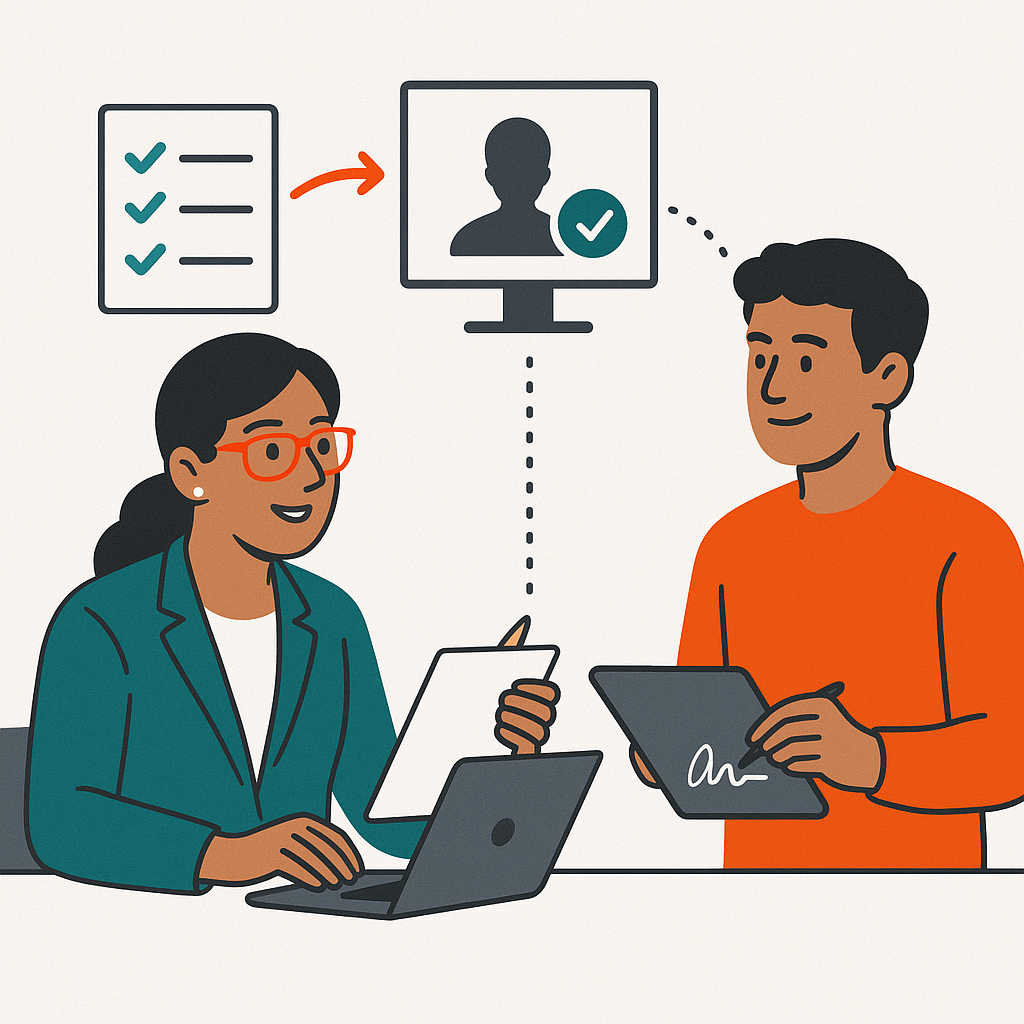
Employee Onboarding in 2026: Paperless HR Workflows with HRDMS
In 2026, employee onboarding software is no longer a “nice-to-have” HR tool—it is the backbone of a measurable, secure, and repeatable joining experience. Distributed hiring, stricter data rules, and candidate expectations for mobile-first experiences have pushed organizations toward a digital onboarding platform that can orchestrate document collection, identity verification, an e-signature workflow, and policy-driven compliance with a defensible audit trail.
The differentiator is not “paperless” alone. It’s governance-grade workflow: every form, task, ID proof, background check, and acknowledgment becomes a controlled record with security, integration, automation, and end-to-end auditability—so HR can scale hiring without scaling risk.
If you’re evaluating onboarding modernization, start with Hridayam’s onboarding solution and align it with your broader content and records strategy using the ECM guide.
Why onboarding breaks at scale (and what 2026 requires)
Traditional onboarding fails for three predictable reasons: fragmented tools, inconsistent controls, and low visibility. The result is rework, delayed Day‑1 readiness, and audit exposure. In contrast, 2026-ready employee onboarding software behaves like a workflow engine plus a content system:
- Workflow orchestration across HR, IT, Facilities, and Hiring Managers with SLA-based task automation.
- Policy-driven controls (retention, redaction, access) applied automatically to onboarding records.
- Integration with HRMS, IAM, background verification, and payroll to prevent duplicate entry.
- Security by design—role-based access, encryption, and evidence-grade logs for audit and governance.
The modern HRDMS pattern: from “forms” to governed employee records
Leading HR teams now implement onboarding through an HRDMS model—HR document management plus workflow—where every artifact is a governed record. A strong digital onboarding platform should cover these technical pillars:
- Unified document collection with mobile capture, validation rules, and metadata indexing for searchability.
- Identity verification checkpoints that match policy (KYC-style controls, liveness/ID matching where applicable).
- E-signature workflow with template-driven packets (offer, NDA, policies) and sequential/parallel routing.
- Compliance controls: retention schedules, consent logs, and least-privilege access.
- Audit trail completeness: who uploaded/edited/signed/viewed, timestamps, IP/device, and version history.
This approach becomes even more powerful when onboarding is connected to enterprise content management. If your organization already runs a DMS/ECM, aligning onboarding records with your repository and governance model reduces duplication and improves audit readiness. Explore enterprise document management capabilities and map them to your HR record taxonomy.
Comparison: checklist onboarding vs. workflow-led employee onboarding software
| Capability | Checklist-based onboarding | Workflow-led onboarding (2026) |
|---|---|---|
| Document collection | Email/drive uploads; manual follow-ups | Guided uploads with validation, metadata, automation |
| Identity verification | Ad-hoc checks; inconsistent evidence | Policy-controlled checks + retained proof + audit trail |
| E-signature workflow | Single doc signing; limited routing | Packet signing, routing rules, reminders, versioning |
| Compliance & audit | Scattered records; fragile audit readiness | Central governance, retention, and defensible audit trail |
Designing the workflow: a practical reference architecture
A resilient employee onboarding software implementation typically follows a reference pattern:
- Trigger: Offer accepted → onboarding case is created with a unique employee ID and workflow state.
- Document collection: Candidate uploads IDs, certificates, and bank/tax forms; OCR/ICR extracts key fields for validation and indexing.
- Identity verification: Rules determine which documents are mandatory, how they’re verified, and what evidence is stored.
- E-signature workflow: Offer letter, NDA, and policy acknowledgments route to candidate and internal approvers.
- Compliance & audit trail: Every step is logged; retention and access policies apply automatically; exceptions create audit-visible cases.
- Integrations: HRMS payroll master creation, IT ticketing for account provisioning, and IAM group assignment.
For teams adopting AI-assisted classification and extraction, align your automation roadmap with the AI automation guide. Use automation to reduce manual indexing—but keep governance strict so your audit trail remains complete.
Privacy-first onboarding: masking, minimization, and controlled access
Identity documents and bank details are high-risk content. In 2026, privacy maturity is a competitive advantage: new hires notice when you handle their data responsibly. Build your digital onboarding platform around minimization and purpose limitation:
- Data minimization: Collect only what you need (tighten document collection templates and rules).
- Masking and redaction: Reduce exposure of national IDs where partial display is sufficient.
- Role-based access: Hiring managers should never access full ID proofs by default.
- Compliance evidence: Consent capture, retention, and access logs must be retrievable for audit.
If you operate in India or handle Aadhaar-based proofs, consider purpose-built controls like Aadhaar masking compliance to reduce exposure while preserving verification value. Connect these controls to your identity verification and audit trail requirements so privacy is enforced by workflow, not training.
Governance that survives audits (and org changes)
A sustainable onboarding program must outlast HR team changes, tool migrations, and policy updates. That’s where governance and records discipline matter. Use the Governance & compliance guide to align onboarding artifacts with a controlled records lifecycle.
Three implementation practices consistently improve compliance outcomes:
- Standardize templates: Packets for role types and geographies reduce variation in e-signature workflow and approvals.
- Exception handling: Missing docs, failed identity verification, or expired IDs become tracked cases—not side emails.
- Audit-ready reporting: Dashboards show completion, outstanding tasks, and policy exceptions with an exportable audit trail.
Where Hridayam fits: onboarding + ECM-grade document control
Hridayam Soft Solutions positions onboarding as an enterprise workflow and content problem—not just an HR form problem. With employee onboarding software built to support structured document collection, consistent identity verification, and a controlled e-signature workflow, HR teams can meet onboarding SLAs while strengthening compliance and preserving a complete audit trail.
If you also need a hardened document repository, centralized search, and role-based access, pair onboarding with an ECM/DMS strategy—many organizations use ShareDocs Enterpriser as part of the broader HRDMS stack. You can also start from the homepage to explore the ecosystem at Hridayam Soft.
FAQ: employee onboarding software in 2026
1) What makes employee onboarding software “enterprise-ready” in 2026?
Enterprise readiness means a governed digital onboarding platform with workflow, strong security, integrations, and a defensible audit trail—not just forms and emails.
2) How do we reduce onboarding delays caused by missing documents?
Use rules-based document collection (mandatory/optional by role and location), automated reminders, and exception queues that route blockers to owners with SLAs.
3) How should identity verification be handled for remote hires?
Remote identity verification should combine guided uploads, validation checks, secure storage of evidence, and restricted access—fully logged in the audit trail for audits.
4) What should we look for in an e-signature workflow for onboarding?
Look for packet-based signing, routing rules, reminders, version control, and tamper-evident completion records that strengthen compliance and reporting.
Ready to modernize onboarding with paperless, governed HR workflows?
Implement employee onboarding software that unifies document collection, identity verification, and e-signature workflow—while improving compliance and strengthening your audit trail.
Request a Demo


No comments:
Post a Comment