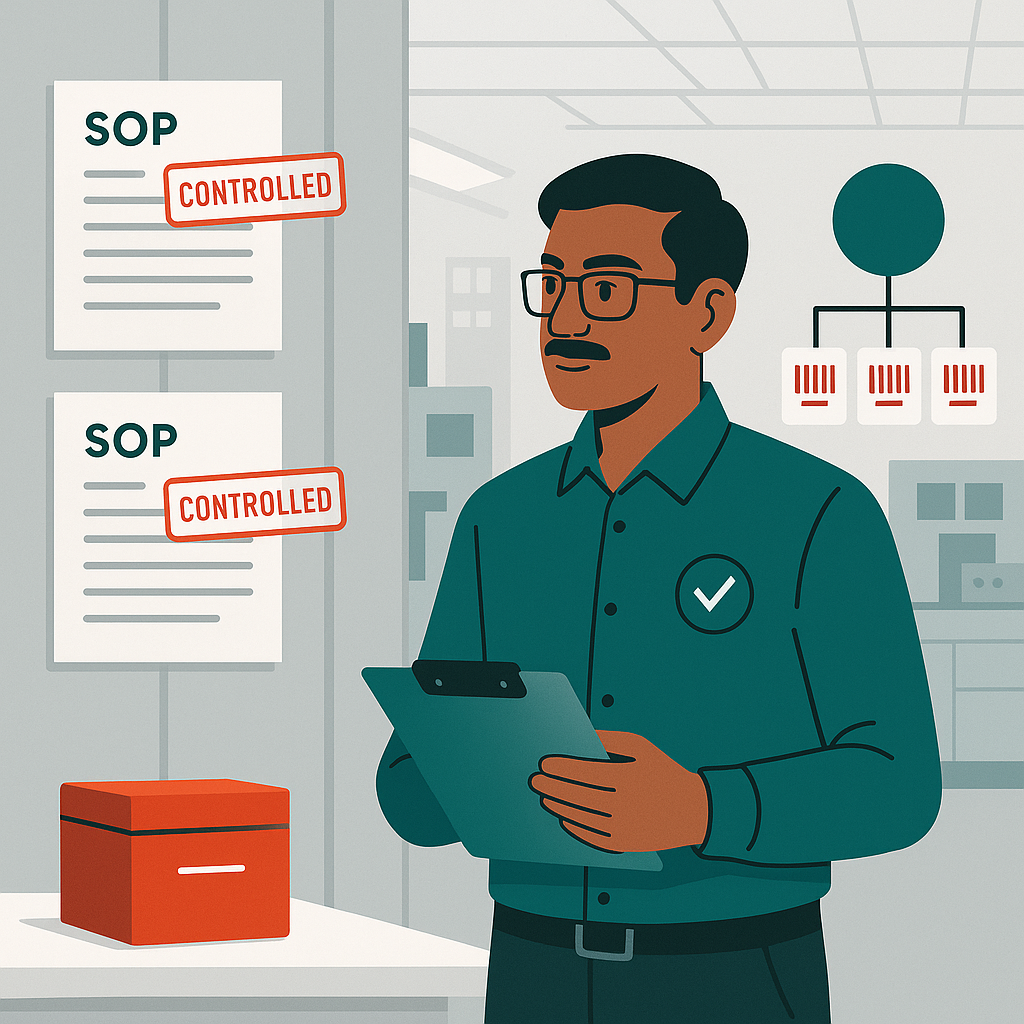
Manufacturing in 2026: SOP Control, Quality Docs, and Audit-Ready ECM Workflows
In 2026, manufacturing document management is no longer an administrative layer around production—it is an operational control surface. As plants modernize MES/ERP stacks, add automation, and tighten cybersecurity, the document backbone becomes the system that proves “what happened, when, by whom, and under which approved instructions.” That proof is built on SOP management, robust quality documentation, disciplined version control, and end-to-end traceability backed by an immutable audit trail for controlled documents.
The manufacturers that outperform in 2026 treat documents like data: governed, secured, integrated, and automated across workflows—without slowing the shop floor. This article outlines the technical patterns that make manufacturing document management audit-ready while still practical for real operators, real shifts, and real deviations.
For an overview of enterprise content foundations, see our ECM guide. For intelligent routing and extraction use cases, review the AI automation guide. And to align policies, retention, and controls, use the Governance & compliance guide.
Why 2026 manufacturing document control fails in “normal” DMS setups
A generic file repository can store PDFs, but it cannot guarantee that the right instruction was used on the right lot, that the approver’s intent was captured, or that evidence is complete when an auditor asks. Manufacturing failures typically come from gaps across five capabilities:
- SOP management that is disconnected from training, equipment, and change control.
- Weak version control where “final_v7” becomes a de facto policy.
- Incomplete traceability between batches, deviations, CAPA, and supplier changes.
- An audit trail that can’t reconstruct review/approval steps with timestamps and identities.
- Unclear boundaries for controlled documents versus drafts, references, and legacy scans.
The modern baseline for manufacturing document management is ECM-style governance: role-based access, workflow automation, metadata standards, integration, and security-by-design. Hridayam Soft Solutions implements these patterns across manufacturing environments where uptime and compliance are both non-negotiable. Explore manufacturing-specific context on our manufacturing industry page and our enterprise document management system solution.
Design pattern: controlled document lifecycle that matches plant reality
A practical lifecycle for controlled documents in 2026 should be explicit, enforceable, and measurable. At minimum:
- Draft: collaborative editing, restricted visibility, no operational use.
- In review: parallel/serial workflow, required comments, risk and impact capture.
- Approved & effective: only this state can be used for production; distribution rules apply.
- Superseded: discoverable for history, blocked from operational use; linked for traceability.
- Obsolete/archived: retention policy enforced; legal hold supported.
This structure strengthens SOP management because it turns policy into workflow automation. It also supports quality documentation by ensuring evidence maps to the effective version. Crucially, it makes version control unambiguous: one effective version at a time, with controlled visibility.
Comparison: folders vs metadata-driven ECM for SOPs and quality
| Capability | Folder-based repository | ECM with governance & workflow |
|---|---|---|
| SOP management | Manual distribution; relies on user behavior | Automated approvals, effective dates, controlled access |
| Quality documentation | Evidence scattered; weak linking | Structured metadata, templates, record associations |
| Version control | Duplicate “final” files; unclear effective version | Single source of truth; enforced states and locking |
| Traceability | Hard to connect lots, assets, changes | Relationship mapping across batch/asset/CAPA/change |
| Audit trail | Basic file timestamps; limited accountability | Event logs for reviews, approvals, access, and exports |
| Controlled documents | Mix of drafts and approved copies | Policy-driven classification and retention controls |
The technical backbone: metadata, integrations, and security controls
A 2026-ready manufacturing document management program is built on a metadata model that supports governance and automation. Think in terms of “searchable evidence,” not “places to store files.” Recommended metadata dimensions include:
- Document type taxonomy: SOP, work instruction, specification, form, deviation, CAPA, COA.
- Site/line/cell, asset ID, and product family for traceability.
- Effective date, review period, and training requirements for SOP management.
- Approval roles and electronic signatures to strengthen audit trail.
- Classification (public/internal/restricted) and retention schedules for controlled documents.
Integrations determine whether your quality documentation is complete. The most valuable patterns connect ECM to MES/ERP/QMS so that: (1) production records link to the effective SOP version, (2) deviations auto-attach evidence, and (3) changes propagate via controlled workflow. Consider extending automation to upstream documents too—invoice and supplier paperwork can be standardized using AI invoice data extraction, improving inbound governance and supplier traceability.
Security is now inseparable from compliance. Implement least-privilege access, conditional access for remote approvals, encryption at rest/in transit, and export controls. These measures directly protect controlled documents and preserve audit trail integrity.
Operationalizing SOPs: from “read & sign” to competency-based execution
Traditional SOP management often ends at publishing. In 2026, it must close the loop: training assignment, competency verification, and evidence capture at the moment of execution. This is where version control and traceability meet real-world work.
- Trigger training workflows when an SOP becomes effective (automation + governance).
- Restrict execution forms unless the user is qualified (security + workflow).
- Link every executed record to the effective SOP revision (strong audit trail).
- Prevent “offline print drift” with controlled distribution and expiry (protect controlled documents).
Even adjacent operational systems can strengthen the compliance story. For example, controlled site access supports incident reconstruction and visitor accountability—see the visitor management system. And for CAPEX governance and maintenance documentation alignment, review our fixed asset management software.
How to measure maturity: evidence latency and audit readiness
Manufacturers often measure document programs by counts (documents created, SOPs updated). In 2026, better metrics are:
- Evidence latency: time between event and complete quality documentation availability.
- Revision adoption time: how quickly the effective version control state reaches all users.
- Trace completeness: percentage of batches with linked SOP revision + equipment + operator.
- Audit reconstruction time: how fast you can produce a defensible audit trail.
Platforms like ShareDocs Enterpriser are designed to support these outcomes with structured workflows, governance, and controlled distribution. To see Hridayam Soft Solutions capabilities and implementation approach, visit hridayamsoft.com.
FAQ: manufacturing SOP and quality document control in 2026
1) What makes a document “controlled” in manufacturing?
Controlled documents are documents with enforced lifecycle states, access rules, retention, and approval requirements—supported by version control and a verifiable audit trail.
2) How many times should SOPs be reviewed?
Review frequency depends on risk, change rate, and regulatory expectations, but modern SOP management uses governance rules: scheduled review cycles plus event-based reviews triggered by deviations, CAPA, or process changes.
3) How do we ensure traceability between batches and SOP versions?
Enforce links between execution records and the effective SOP revision using metadata and integrations to MES/QMS. This provides end-to-end traceability and supports rapid audit responses with a complete audit trail.
4) What is the biggest mistake with quality documentation?
Treating quality documentation as “attachments in folders” instead of structured evidence. Without standardized metadata and workflow automation, version control, traceability, and audit trail quality degrade quickly.
Build audit-ready manufacturing document management for 2026
If you’re modernizing SOP control, quality evidence, and governance across sites, we can help you design an ECM workflow that is practical on the shop floor and defensible in audits.
Request a Demo


No comments:
Post a Comment