Legal Teams in 2026: Matter Files, Secure Access, Evidence-Grade Audit Trails
In 2026, legal document management is no longer a “repository problem”—it’s a defensibility problem. Regulatory timelines are shorter, collaboration is more distributed, and courts expect transparency in how evidence was handled. Modern legal operations must connect matter management, legal hold, and an evidence-grade audit trail into one coherent system that supports secure sharing, eDiscovery readiness, and strong document governance.
This thought-leadership perspective outlines what “good” looks like in 2026: governance-by-design, policy-driven workflow, and integrations that reduce risk rather than add tools. For a broader content foundation, align legal requirements with your enterprise stack using the ECM guide, the AI automation guide, and the Governance & compliance guide.
Why “evidence-grade” audit trails became the new baseline
An audit trail used to mean “who edited a file and when.” In 2026, it means proving chain-of-custody and demonstrating policy enforcement: immutable event logs, identity signals (SSO/MFA), IP/device context, and retention decisions. When your legal document management platform can show how content flowed through intake, review, approval, and external collaboration, you reduce disputes over authenticity and process.
- Granular event logging: view, download, share, comment, annotation, redaction, and export.
- Policy-proofing: demonstrate that document governance rules were applied at the moment of action.
- Defensible retention: retention schedules + holds, with exceptions documented and time-stamped.
- Operational continuity: auditability across workflow and integration points (email, DMS, CLM, case tools).
Matter-centric information architecture: files that behave like cases
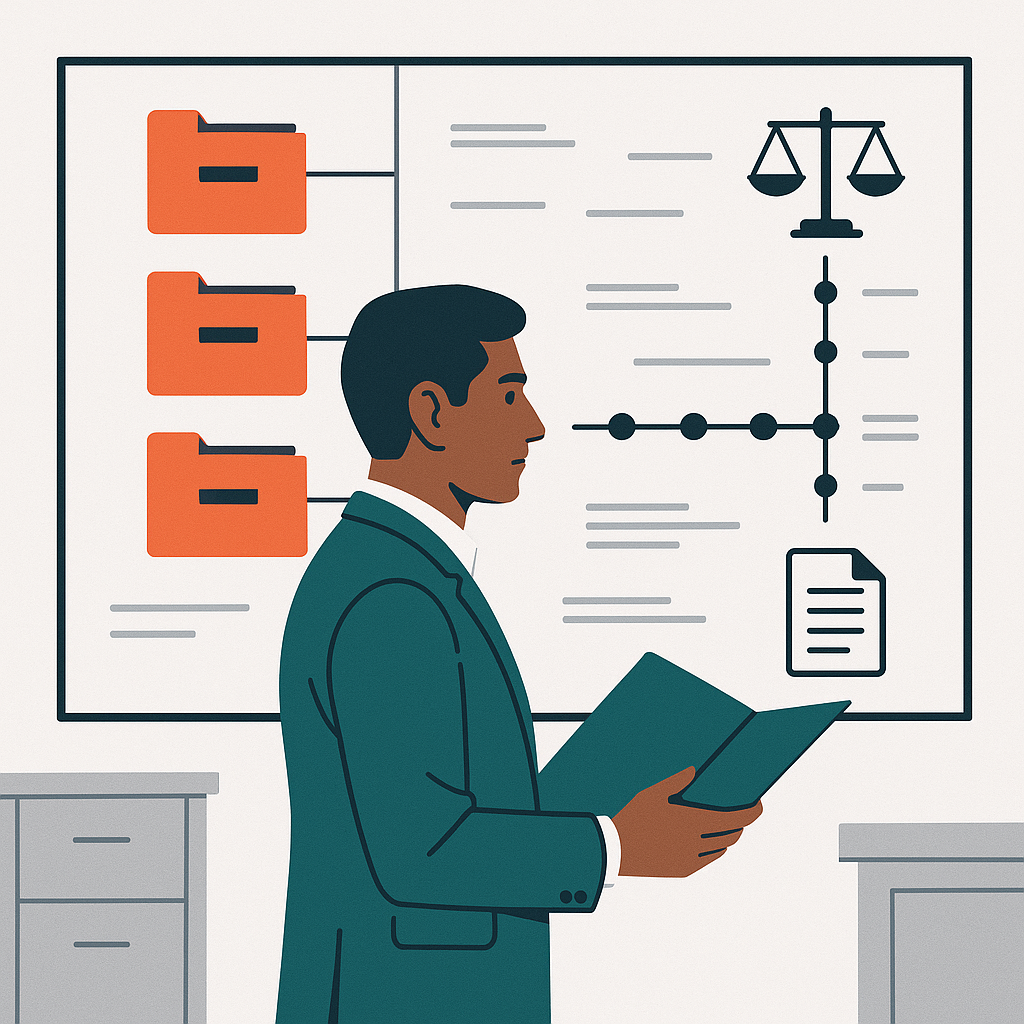
Legal teams don’t manage “documents”; they manage outcomes. That’s why 2026 best practice is matter-centric architecture: every document, email, transcript, and exhibit inherits matter metadata and policy automatically. This closes the gap between matter management and content control, and it improves eDiscovery readiness because collection sets and searches are already scoped correctly.
To operationalize this, define a matter template that includes standardized folders, tags, retention rules, and sharing boundaries. If you’re modernizing, start with a platform built for enterprise control such as an enterprise document management system and configure legal-specific patterns. Explore legal industry implementation context on Hridayam Soft’s legal industry page.
Secure sharing without losing custody: the 2026 collaboration model
External collaboration is now constant—co-counsel, experts, clients, regulators. “Send a PDF” is no longer acceptable when sensitive data, privacy constraints, and litigation risk collide. Secure sharing in 2026 means expiring access, watermarking, granular permissions, download controls, and continuous visibility through the audit trail.
- Controlled access: role-based permissions tied to matter roles (lead counsel, reviewer, client viewer).
- Share links with safeguards: expiration, view-only, domain restrictions, and revocation.
- Automated redaction workflows: reduce manual errors and improve privacy compliance.
- Integrated sign-in: SSO + MFA ensures identity is attributable in the audit trail.
When secure sharing is embedded into legal document management, your team avoids shadow IT and scattered copies. If you’re evaluating a legal-ready DMS, you can also review ShareDocs Enterpriser for a controlled collaboration approach designed for enterprise content workflows.
Legal hold as a lifecycle control, not a panic button
A legal hold must be precise, provable, and fast. In 2026, the maturity shift is from “issue hold notices” to “enforce preservation across systems.” That requires automated triggers (case opened, investigation flagged), custodians mapped to identity directories, and hold-aware retention so nothing is destroyed incorrectly.
Strong document governance makes legal hold less disruptive: retention schedules run normally, but holds suspend disposal only where required. The best systems also keep a defensible record of notifications, acknowledgements, scope changes, and releases—each action recorded in the audit trail.
Comparison: basic repositories vs. 2026-grade legal document management
| Capability | Basic repository | 2026 legal-grade approach |
|---|---|---|
| Matter-centric structure | Folders by team preference | Matter management templates + enforced metadata |
| Preservation controls | Manual “do not delete” | Policy-driven legal hold + hold-aware retention |
| Defensibility | Limited logs | Evidence-grade audit trail across workflow & integration |
| External collaboration | Email attachments | Secure sharing with revocation, watermarking, access expiry |
| Discovery posture | Ad-hoc collections | eDiscovery readiness via standardized metadata + export sets |
| Policy control | Guidelines, inconsistent use | Enforced document governance with automation |
Implementation blueprint: what to prioritize first
Successful programs focus on high-leverage controls rather than “migrating everything.” Prioritize the parts that most improve defensibility and speed: metadata, workflow, and integration.
- Define matter taxonomy: matter types, phases, roles, and required fields for consistent matter management.
- Standardize governance rules: retention schedules, access tiers, and review workflows under document governance.
- Automate preservation: triggers and scoped legal hold actions with acknowledgements recorded.
- Harden collaboration: replace ad-hoc sharing with secure sharing policies and link controls.
- Prove defensibility: validate audit trail completeness with periodic audit reporting.
- Design for discovery: export formats, collections, and indexing for eDiscovery readiness.
If you need an enterprise roadmap that connects governance, workflow automation, and security controls, start at Hridayam Soft and align your legal program with broader enterprise initiatives. Hridayam Soft Solutions typically recommends piloting one matter type (e.g., contracts disputes or investigations) and scaling templates once performance and defensibility metrics stabilize.
FAQ: legal document management, holds, and audit trails in 2026
1) What makes an audit trail “evidence-grade”?
An evidence-grade audit trail captures immutable, time-stamped events across the document lifecycle—access, edits, shares, exports, retention decisions, and legal hold actions—linked to verified identities and policies.
2) How does matter management improve eDiscovery readiness?
Strong matter management ensures documents inherit consistent metadata, custodians, and scope boundaries—so collections, searches, and exports are faster and more defensible, improving eDiscovery readiness.
3) Can secure sharing still allow collaboration with external parties?
Yes. Secure sharing enables controlled access (view-only, expiration, watermarking, revocation) while keeping visibility through the audit trail—reducing reliance on email attachments and uncontrolled copies.
4) What is the relationship between document governance and legal hold?
Document governance defines retention and access rules; legal hold temporarily overrides disposal for scoped content and custodians. When combined, they preserve what’s required without freezing everything.
Ready to modernize legal document management for 2026?
Build defensibility with matter-centric workflows, evidence-grade audit trails, secure sharing, and automated legal hold—without losing enterprise governance. Hridayam Soft Solutions can help you design a scalable approach that improves eDiscovery readiness and reduces risk.
Request a Demo


No comments:
Post a Comment